
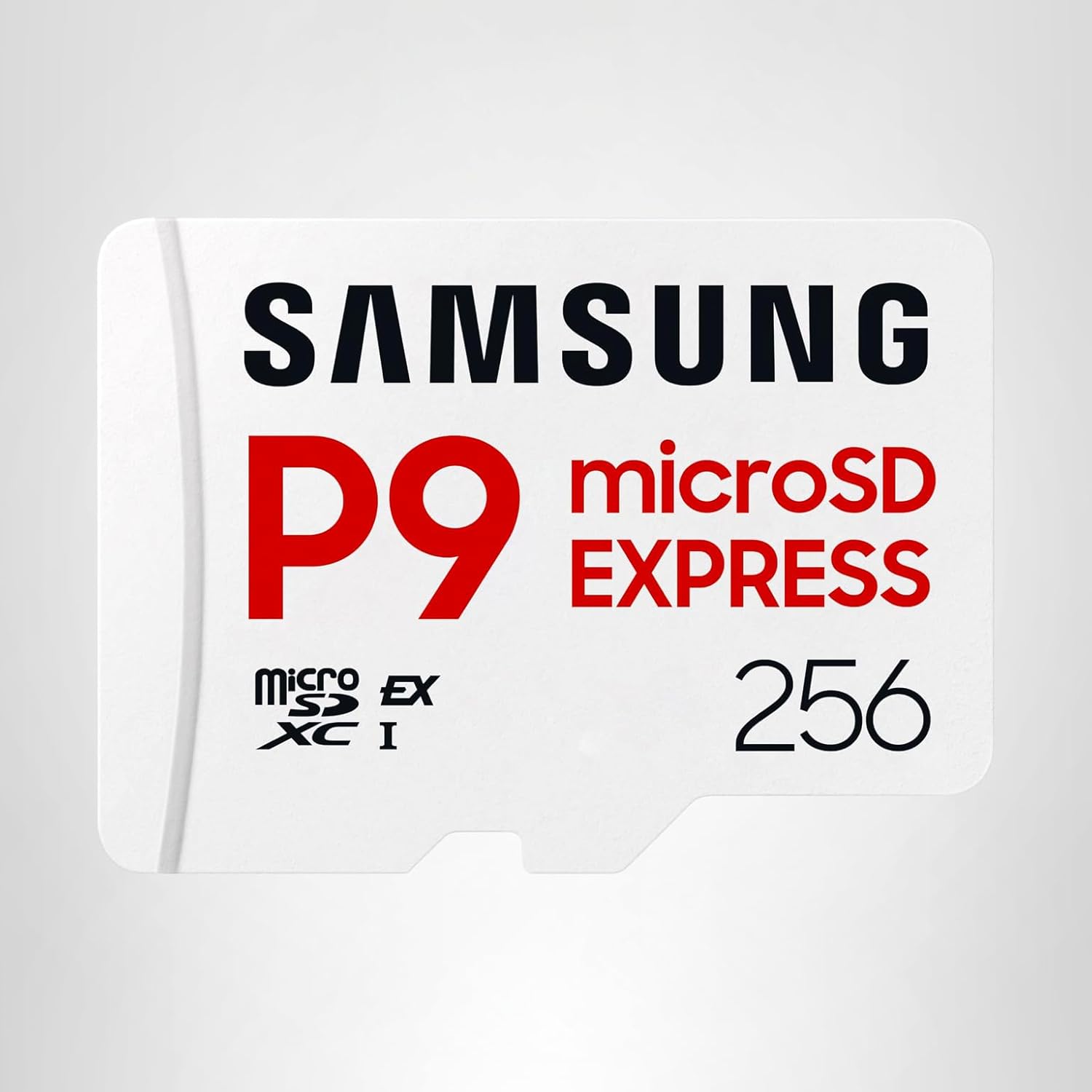
The digital landscape is constantly evolving, demanding faster and more robust storage solutions, especially in the realm of handheld gaming and high-resolution media capture. Samsung has answered this call with the P9 Express microSD Express Card, a next-generation memory card that leverages the advanced SD Express standard. Specifically, the 256GB model (MB-MK256T/AM) positions itself as a crucial upgrade, particularly for users of the new Nintendo Switch 2, which is designed to take full advantage of the PCIe 3.0 interface and NVMe protocol offered by microSD Express. This review delves into why the P9 Express is considered a game-changer and explores its competitive edge.
The Power of PCIe: Blazing Fast Speeds
The defining feature of the Samsung P9 Express is its reliance on the PCIe Gen 3.0 x1 interface, coupled with the NVMe 1.3 protocol. This hardware combination fundamentally differentiates it from traditional microSD cards, which are limited by the slower UHS-I interface. The result is a card capable of delivering sequential read speeds of up to 800 MB/s. This incredible speed is crucial for minimizing load, installation, and update times, turning frustrating waits into near-instantaneous experiences, especially in data-intensive applications like gaming and 4K/8K video recording.
For gamers, particularly those using the Nintendo Switch 2, the P9 Express ensures that the experience feels seamless, minimizing the performance difference between loading a game from the card and loading it from the console's internal storage. While real-world random read/write speeds—which are more indicative of gaming performance—may be lower than the sequential advertised speed, the P9 Express still provides a significant boost over older technology, with random read/write IOPS rated up to 65K/52K respectively. The card also supports the older UHS-I standard, offering backward compatibility, albeit limited to UHS-I speeds (around 90 \text{ MB/s} sequential read).
Built for the Future: Design and Durability
Beyond sheer speed, Samsung has engineered the P9 Express with a suite of features to ensure reliability and longevity. The card incorporates Dynamic Thermal Guard (DTG) technology, a critical component for high-speed operation. By actively managing the card's temperature, the DTG prevents performance throttling during extended, demanding sessions, ensuring sustained performance and a consistent, lag-free experience.
Furthermore, the P9 Express boasts Samsung’s robust "six-proof" durability. This includes resistance to water, extreme temperatures, X-rays, magnets, drops, and wear-out, providing users with peace of mind that their valuable data is protected in almost any environment. With an endurance rating (TBW) of up to 100TB and a 3-year limited warranty, the P9 Express is built to last, offering premium performance with strong protective measures.
Advantages (Pros)
Extreme Sequential Read Speed: Up to 800 \text{ MB/s} utilizing the PCIe Gen 3.0 x1 and NVMe 1.3 interface, dramatically reducing load and transfer times.
Next-Gen Gaming Performance: Specifically optimized for devices like the Nintendo Switch 2, providing an experience very close to the console's internal SSD.
Enhanced Durability: Features a robust "six-proof" design (water, temperature, X-ray, magnet, drop, and wear-out proof) for maximum reliability in various environments.
Thermal Control: Dynamic Thermal Guard (DTG) ensures sustained high performance by preventing overheating and thermal throttling.
Backward Compatibility: It can be used in older microSDXC slots, though performance will be limited to UHS-I speeds.
Disadvantages (Cons)
Limited Host Compatibility: The full 800 \text{ MB/s} speed is only achievable in devices that support the microSD Express standard (PCIe/NVMe), such as the Nintendo Switch 2 and a limited number of express card readers. Many current devices remain restricted to the much slower UHS-I speed.
Random Speed Real-World Test Variation: While sequential speeds are high, practical application performance (like game loading) is governed by random read/write speeds, which, while excellent, are not 800 \text{ MB/s}. Users may need a dedicated microSD Express reader to experience the full sequential read/write benefits for file offloading.
Cost: As a bleeding-edge technology, the P9 Express card tends to be more expensive than equivalent capacity UHS-I or even UHS-II cards.
Conclusion
The Samsung P9 Express 256GB microSD Express Card (MB-MK256T/AM) is not just another memory card; it is a dedicated piece of next-generation hardware designed to unlock the full potential of devices like the Nintendo Switch 2. It sets a new benchmark for speed and performance in the microSD form factor. For the early adopter of next-gen handheld gaming or the professional seeking the fastest possible storage for high-resolution content creation, the P9 Express is a compelling, high-value investment, provided their host device is equipped to handle the SD Express standard.